

Merusaka Nusa Dua
Nearest Airport : DPS (13 km away)
Neighbourhood : Nusa Dua, Bali
Website : merusaka.com
Address : ITDC Nusa Dua Lot S-3, Benoa, Badung, Bali 80363
Chain : Meru Hotels (HIG)
Originally opened as Putri Bali in 1985, the hotel was built as part of the Nusa Dua development initiative, which sought to establish Bali as a destination for international-class resorts. Following the opening of The Nusa Dua Beach Hotel, Putri Bali became the second hotel to welcome guests in the newly inaugurated enclave. After a complete rebuild in 2012, the nine-hectare property was reborn as INAYA Putri Bali, reflecting a new vision for the state-owned hotel brand.
The hotel finally evolved into what it is today in 2021, when Hotel Indonesia Group consolidated its most upmarket properties under the Meru Hotels brand. The name Merusaka itself is derived from two Sanskrit-influenced words – meru, referring to the sacred Mount Meru in Hindu cosmology, and saka (from pusaka, meaning ‘sacred heritage’) – giving the hotel a name deeply rooted in Balinese culture.
Booking Merusaka
For this stay, I paid a nightly rate of IDR 1,975,000 (~ USD 110 or GBP 83) for an entry-level Deluxe Room, which I booked on Agoda.com. This is one of the lower rates I’ve seen for the Merusaka resort, which surprisingly commands comparable rates to its name-brand neighbours. It was more so surprising considering the resort’s relatively uninspiring-looking rooms. Does the place have some special charm? In any case, I was keen to finally check out this property.
Location
Located within the gated Nusa Dua complex, Merusaka is wedged between two of Bali’s largest beachfront resorts – Grand Hyatt Bali and Ayodya Resort. While the area is renowned for its pristine white-sand beaches and manicured surroundings, it is also a decidedly upmarket enclave that can feel rather sterile compared to the rest of Bali. As such, dining options are largely limited to the restaurants within the area’s resorts, alongside those at the nearby Bali Collection shopping centre. It also goes without saying that there isn’t much of note in the area, making it perfect for a lazy beach holiday.


Check-in
We arrived at Merusaka following an uneventful flight from Jakarta aboard Batik Air. Having rented a car, it was a straightforward 20-minute drive to the Nusa Dua enclave via the Bali Mandara Toll Road. After a brief security check at the entrance to Nusa Dua, we soon encountered a second, more thorough inspection at the entrance to the resort itself. From there, we continued along the long, winding driveway before eventually arriving beneath the hotel’s impressive lobby.


At the porte-cochère, however, we were met with an empty forecourt, devoid of any staff. No matter, I unloaded our luggage and left it by the driveway before heading inside to locate a staff member who could look after it. After receiving confirmation that our bags would be taken care of, I proceeded to the reception desk to check in.


There, I was greeted by a friendly reception agent who confirmed our two-night reservation. As we had arrived before the 15.00 check-in time, our room was understandably not yet ready. No biggie. Since we had plans for the day, I asked if the hotel could store our luggage in the meantime. Confusingly, however, the staff struggled to ‘find’ our bags and seemed unsure which luggage I was referring to. Imagine my surprise when I stepped back outside to discover that our luggage was still sitting exactly where I had left it by the driveway. Hmm…


When we returned later that day, exhausted, we were finally able to collect our room keys. Merusaka comprises seven accommodation buildings, known as puri – the Balinese word for a royal residence – each named after a Hindu goddess. We were assigned a top-floor room in Puri Dewi Rukmini.


The hotel offered to take us there by buggy, which initially struck me as a little unnecessary. However, after waiting around ten minutes without one arriving, I was keen to walk instead. As it turned out, a driver eventually appeared, and the ride made it clear why the service was offered in the first place – our building was considerably farther from the lobby than I had expected.
Deluxe Room
The entry-level Deluxe Room measures a generous 48 sqm (517 sqft), making it one of the largest standard rooms in Nusa Dua. Like many resorts in Bali, it also features a sizeable balcony and an equally spacious bathroom. While those are certainly welcome additions, Merusaka unfortunately has one of the least appealing interior designs I’ve encountered at a five-star resort on the island.


Bedroom
As you enter the room, you’re immediately greeted by the bedroom, which stretches the full length of the space towards the balcony. The layout is fairly conventional, with two beds occupying the centre of the room, followed by a small living area by the windows comprising a desk and an L-shaped sofa. In terms of functionality, this seating area is certainly a welcome addition to an otherwise unremarkable room, especially considering how many modern resorts have chosen to do away with desks altogether. One design detail I was less fond of, however, was the open wardrobe positioned beside the bed, meaning you’ll inevitably be sleeping next to a mirror – admittedly a rather minor quirk of mine.


Despite the functional design, I’ll note that the room’s design lacks the cohesion needed to tie the space together. While one half of the room is finished with attractive timber flooring, the other is clad in rather uninviting travertine-effect porcelain tiles that honestly look cheap. Furthermore, the bed’s unusually short headboard, coupled with the rather perplexing carved artwork behind it, leaves the room feeling less premium than it ought to. I’d say the same of the desk and coffee table, which feel more at home in a rural café trying to appear trendy than in a five-star Balinese resort.


Notably, the air conditioning in our room also started leaking at one point during our stay. While things like this happen, I would have hoped that they would have proactively checked the system to prevent these things from happening.


Bathroom
The bathroom occupies a long, narrow space running parallel to the bedroom. While this layout has the potential to be beautifully executed – much like the bathrooms at Tanah Gajah Ubud – the reality here is anything but. Between the travertine-effect porcelain wall tiles, dull grey flooring, cool-toned lighting, and the awkward step up to the bathtub, the bathroom feels cold, uninviting, and ultimately rather unattractive.


In objective terms, I’ll note that the bathroom is equipped with both a freestanding bathtub and a separate walk-in shower fitted with rain and handheld showerheads. Separating the two is a large terrazzo vanity with dual sinks. Water pressure from both the shower and bathtub was rather underwhelming, although the temperature remained thankfully consistent throughout my stay. I’ll also add that Merusaka uses house-branded toiletries, which were perfectly serviceable but otherwise unremarkable.


While the bathroom looked rather unattractive, I was even more surprised to find murky water flowing from the taps as I was about to take a bath. The discoloured water was apparently caused by a fault at one of the treatment plants supplying the hotel. Thankfully, the issue was promptly resolved by a friendly member of the engineering team, who ensured that every tap in the suite was running clear again.

Amenities
Thanks to the resort’s relatively dense arrangement of hotel buildings and villas, large expanses of open space remain throughout the grounds. One of the most striking examples is the expansive lawn that stretches beyond the oblong-shaped lobby building, its sheer scale creating the impression that the resort is larger than it actually is. Personally, I would have preferred to see a lush, manicured Balinese garden in its place, but to each their own.


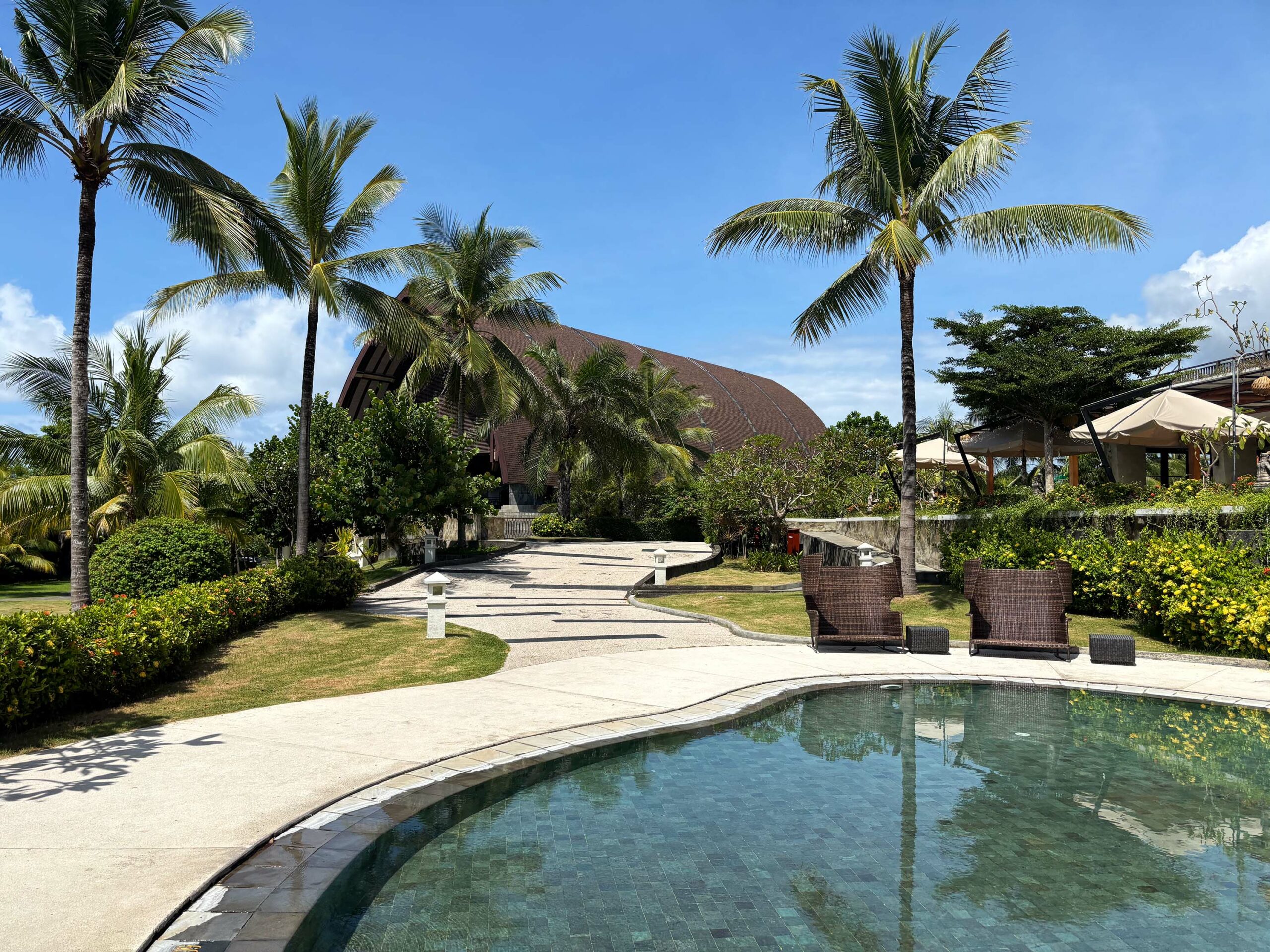
While I have criticised the lack of cohesion in the bedroom design, unfortunately this issue extends throughout the rest of the resort as well. Whereas the lobby is housed beneath a beautiful traditional-looking pyramidal roof, the remainder of the property features a mishmash of seemingly disconnected architectural elements. In many ways, the resort feels like an unholy amalgamation of individually attractive features brought together without a clear design language – as if the property had been repeatedly patched and altered over time with little regard for the overall aesthetic. This is frankly such a shame considering how much history the property actually has.
Main Pool
Perhaps the resort’s single most impressive feature is its three-tiered pool, which I imagine draws inspiration from Bali’s famed stepped rice terraces. Organic in shape, the ocean-facing pool is divided across three levels, each lined with its own row of sun loungers. I must say this is a particularly clever design choice, as it prevents the pool from feeling overcrowded by creating multiple distinct areas within a space that could otherwise only accommodate a single pool. While the setting is undoubtedly beautiful, the view is unfortunately compromised by the concrete pool deck and glass wedding chapel that protrudes into the space like a sore thumb.


Children’s Pool
Located beside the main pool is the children’s pool, comprising a small, shallow swimming pool surrounded by a handful of sun loungers. Beyond that, there are no additional amenities of note for this wading pool.


Paradise Beach Club pool
In addition to the resort’s three-tiered main pool, there is also a second pool located beside the beach as part of the Paradise Beach Club. Unlike the main pool, this one is considerably smaller. Furthermore, its organic shape makes it better suited to leisurely dips than proper lap swimming. It does, however, feature an interesting jumping platform that leads into a smaller yet noticeably deeper pool set apart from the main section. Much like the main pool, the beachfront pool is also surrounded by rows of sun loungers.


Fitness Centre
Located behind the beachfront pool, the resort’s fitness centre is tucked away across from the pool’s jumping platform. Compared to the size of the resort, the gym itself is rather compact and somewhat sparsely equipped.


That said, provided it isn’t too busy, it remains a pleasant place to get in a workout. Otherwise, those looking for something a little more active may prefer the resort’s beachfront volleyball court instead.
Beach
One of Merusaka’s main selling points is undoubtedly its direct access to Nusa Dua Beach, where an extensive row of sun loungers lines the beachfront. Compared to the resort’s overall size, however, its beachfront is relatively narrow, especially when measured against neighbouring Grand Hyatt Bali. Even so, the hotel occupies a lovely stretch of coastline, with fine white sand and calm waters that are well suited to swimming.


Three closely spaced rows of sun loungers line the beachfront, giving the area a slightly more impersonal feel than those at the higher-end resorts nearby. A further four rows are arranged across the garden behind the beach, although these receive considerably less direct sunlight throughout the day. Towels are conveniently available from a towel hut located just behind the loungers.


Traditional Market
In front of the Puri accommodation buildings, Merusaka has recreated a traditional Balinese market as part of its ‘My Kampung Experience’ initiative. In concept, this is a genuinely charming way for the hotel to facilitate cultural exchange for international guests while also supporting local Balinese merchants.


Unfortunately, the execution leaves something to be desired, as many of the vendors would call out to guests walking towards their rooms to promote their merchandise, which could potentially make some guests feel uncomfortable. Furthermore, I was disappointed to see some merchants selling counterfeit branded goods, which certainly wasn’t a great look.
Service
Although the majority of the hotel’s staff members I encountered were friendly and well intentioned, the service overall came across as somewhat amateurish compared to that at other resorts in the area. On the one hand, nobody was ever short of a smile or a warm greeting, which always helps create a welcoming atmosphere. On the other hand, I found the service to be rather slow and occasionally lacking in attention to detail. Aside from the mishaps during our arrival, housekeeping requests often took a long time to fulfil. Even then, some requests were misinterpreted – for example, my request for a shaving kit was mistakenly fulfilled with a sewing kit instead. So that’s something of a shame.
Overall
Honestly, I found Merusaka to be a rather difficult resort to assess. On one hand, I appreciated the property’s efforts to incorporate Balinese culture, particularly through its My Kampung Experience initiative. I also thought the beachfront setting and resort facilities were pleasant enough. On the other hand, I found the guestrooms uninspiring, and the resort ultimately lacks a compelling unique selling point – at least from my perspective. As a result, I found it difficult to choose Merusaka over the many competing resorts in Nusa Dua since, I do feel there are stronger options in the area at a similar price point.
Leave a Reply